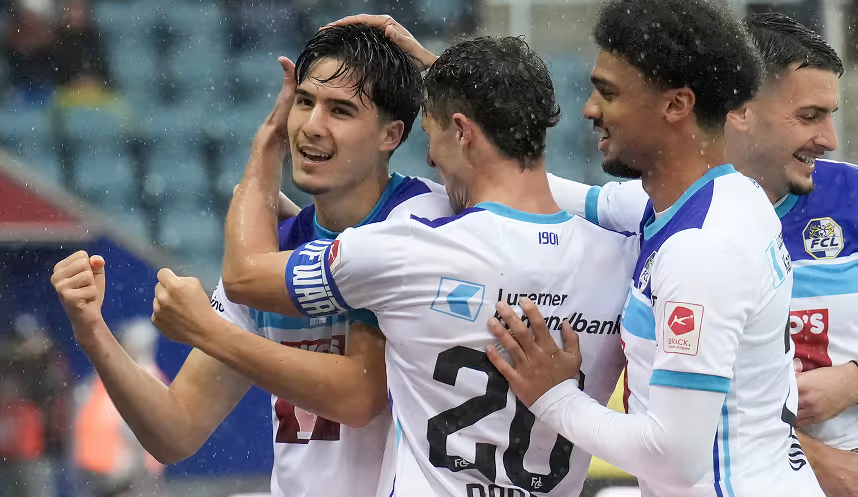
From FC Luzern’s inner circle to your workplace: 5 habits that build resilient teams
May 18, 2026
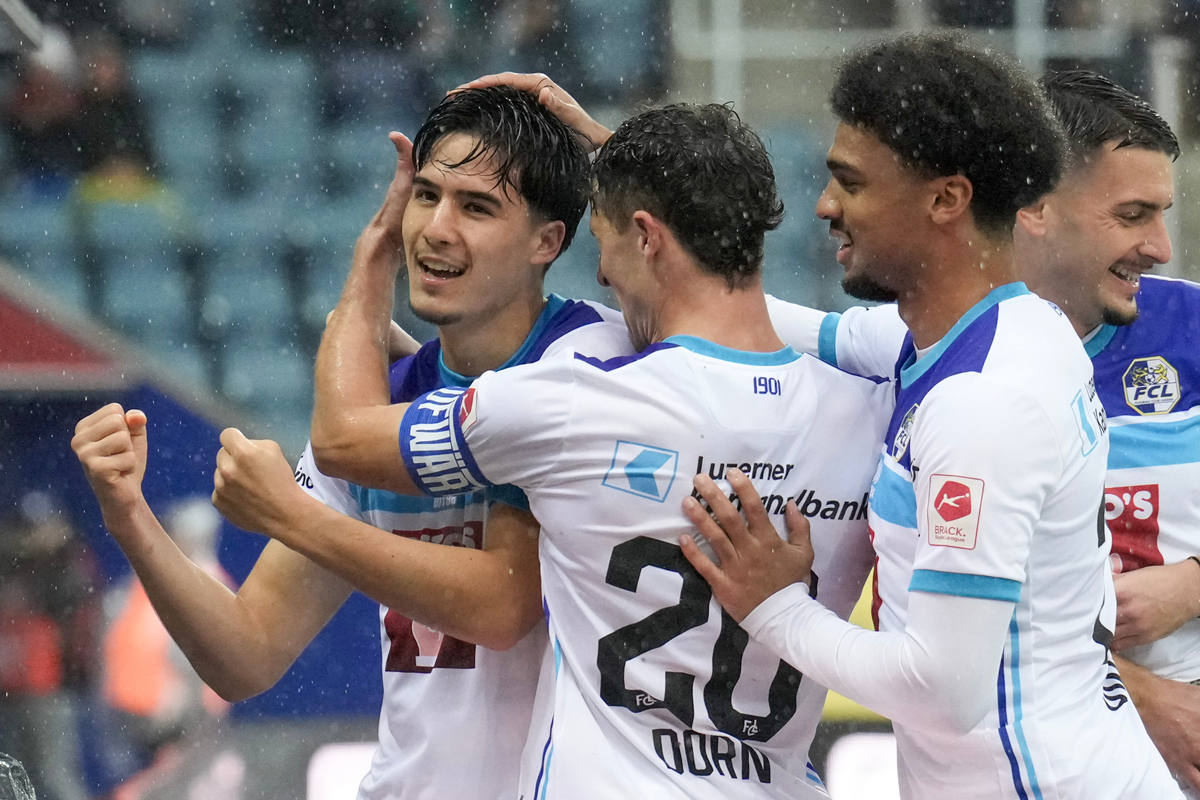
FC Luzern isn’t just a football club. It’s one of Europe’s most consistent youth development systems, giving nearly half of all first-team minutes to players under 21. Their academy is built on clear roles, psychological safety, structured recovery, and real-time learning—exactly the ingredients modern workplaces struggle to scale. That’s why we went inside their system for this piece.
You’re 17, stepping onto the pitch at FC Luzern’s Swissporarena for your debut. You misplace your first pass. The crowd reacts—sharp, immediate. But there’s no panic. A teammate gives a quick signal, the shape resets, and play moves on. That’s resilience: a trained response under pressure, not an accidental one. And at FC Luzern, these moments aren’t rare—they’re routine.
This doesn’t happen by chance. It’s trained, reinforced, and embedded in the club’s culture. FC Luzern has built a system where resilience isn’t an individual trait, but a collective skill. The good news: the same principles translate surprisingly well to the workplace.
The modern office faces a similar pressure curve to that of sports. 44% of employees worldwide say they experience stress for much of the day, which is the highest level since the survey began. The World Health Organization estimates that depression and anxiety already cost businesses 12 billion working days each year—equal to US $1 trillion in lost productivity.
So instead of asking how to reduce pressure, we asked a different question: how do high-performance systems train people to function when pressure is unavoidable?
In the next sections, we’ll unpack how FC Luzern trains resilience and how you can translate those habits into your own teams. Their insights—paired with globally recognized research—form five repeatable habits, plus a practical workshop blueprint that you can start running with your teams tomorrow.
Say hello to our expert interviewees
To understand how resilience works under real pressure, we went straight to the source. Here are the experts who train it on the pitch, embed it in culture, and translate it into the workplace.
How FC Luzern hardwires resilience into everyday work
Resilience at FC Luzern isn’t left to chance. It’s built into the way the club operates. At the heart of it is the Youth Foundation FC Luzern Central Switzerland, the foundation that runs the club’s youth academy and underpins one of the most consistent talent pathways in Swiss football.
FC Luzern gave 46.7% of all playing minutes in the 2024/25 season to their under-21 players—that’s ranking them 11th worldwide across more than 1,000 clubs, and 5th in Europe. Internally, the club aims for around 30% homegrown players in the first team—a number that’s currently exceeded, as they’re sitting closer to 50%.
This is a clear signal of a strategy that consistently develops young players and puts them into real pressure situations instead of protecting them from it. This philosophy shows up across the whole club, not just in the youth team.
- An error-positive culture where coaches openly share their own “mistake of the week” to model vulnerability and normalize learning under pressure.
- Academy routines that reward character as much as skill.
- Individualized development plans and close mentorship for high-potential players—not to fast-track them, but to prepare them for setbacks they haven’t yet experienced.
- A structured approach to recovery—physical, mental, and social.
- Clear expectations and pecking order norms that give young players psychological safety and predictable structure when entering a new team.
Across all of this sits a simple idea: players are developed as people first. As mental coach Rüdiger Böhm puts it, “If you only fix the symptom, it explodes later. Sustainable resilience comes from knowing who you are, what you stand for, and how you respond when things go wrong.”
The result is that resilience becomes a shared practice, not an individual burden—a system strengthened by relationships, clarity, and collective responsibility rather than heroics. For organizations, the parallel is clear. Resilience is stronger when it’s embedded in culture, processes, and leadership—not when it depends on personal endurance alone.
How to build resilient teams: 5 habits from FC Luzern
When we asked people inside FC Luzern what resilience really looks like, nobody talked about toughness or motivation. They talked about habits—the things you do automatically when pressure hits. Resetting quickly. Deciding clearly. Protecting energy. Trusting each other. Learning fast after setbacks.Across dozens of examples, the same five habits surfaced again and again. Here’s how they work on the pitch—and how you can translate that directly into your workplace.
Habit 1: Reset fast, move forward
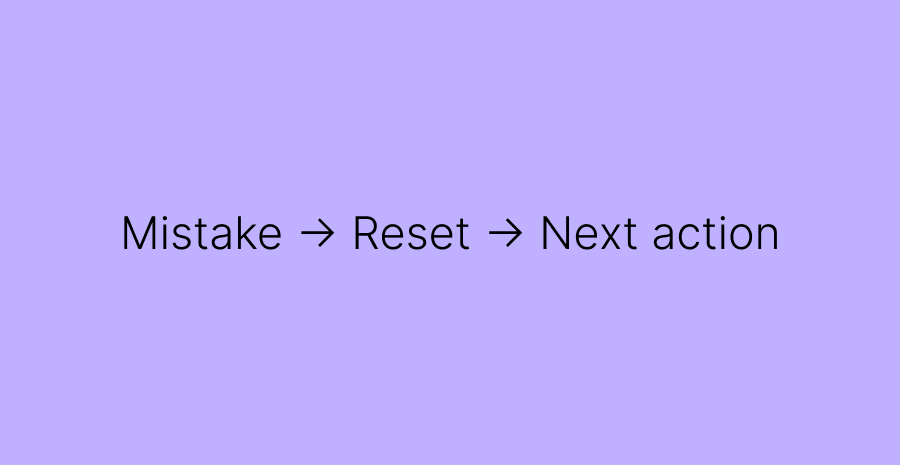
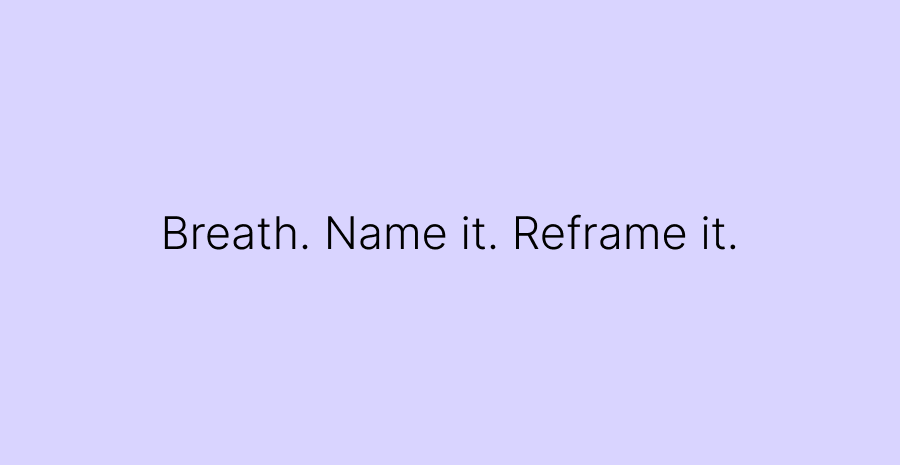
Pressure exposes teams—and the first thing it shows is how they respond to errors. At FC Luzern, mistakes aren’t moments to avoid; they’re moments to reset. The faster the reset, the faster performance returns. That same muscle is one that workplaces need badly.
What it looks like in football
At FC Luzern, mistakes aren’t interruptions—they’re part of the developmental system. Players are taught to cycle back to neutral fast. Coaches model vulnerability by sharing their own “mistake of the week.” And body language is treated as a skill: “What matters isn’t the error,” Youth Talent Lead, Pius Kaspar, told us, “butwhat the player does in the seconds after.”
Rüdiger adds the mental framing: one mistake never defines the result.
“No one becomes a professional because of one great action,” he says, “and no one loses a contract because of a bad pass. What matters is how quickly you re-focus on the next task.”
Resetting is not optional—it’s trained.
What it means for teams
Pressure is chronic—and the cost is real. Poor mental health is a productivity issue as much as a human one. Beyond the health of your team, depression and anxiety can cost you the health of your businesses through lost working days, income, and productivity. In Switzerland alone, stress costs reach billions every year through healthcare expenses and absence-related losses.
The workplace equivalent of a bad pass is a missed deadline, a difficult meeting, a mistake in a client call; or simply being so buried in low-value tasks that you can’t see what actually matters anymore.. Without a reset habit, stress compounds and spreads.
“At work, you absorb a lot of emotion. If you don’t learn a reset routine, you carry your day into your night. Resetting isn’t a luxury—it's a survival skill” says Claire Hilbrink-Damen, Head of People at grape.
What FC Luzern teaches us
1. Reset is embodied, not intellectual: “It almost always goes through the body,” Pius says. Players are trained to stand tall after errors, not collapse into self-critique. The physical cue is the reset.
2. Coaches avoid piling on: “When a player makes a mistake, the coach doesn’t jump in,” Pius said. “The player already knows. How fast can they stand up again?”
3. Mistakes are normalized—even celebrated: Coaches share their own errors. It signals that errors are data, not judgment.
Try it with your team
Implement a 2-minute reset protocol—the same exact logic that elite athletes use.
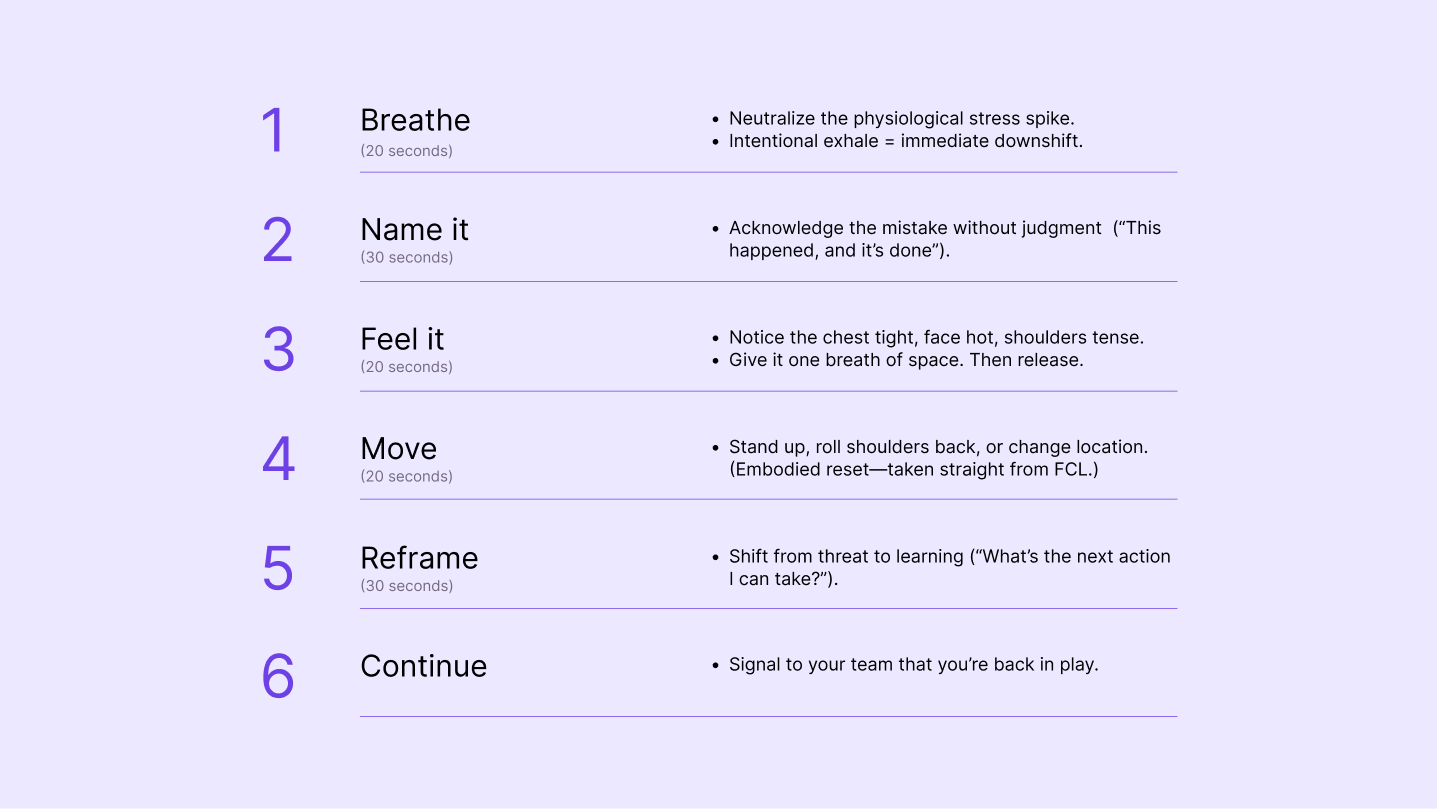
For leaders: give a script for de-escalation instead of correction.
Think more in terms of: “You’ve got this—on to the next action.”
Why it works
Teams that reset quickly prevent stress spirals before they spread. They reduce absence risks, protect energy, and maintain performance consistency. And psychologically, a normalized error culture helps people contribute without fear—mirroring how FC Luzern keeps young players calm under immense pressure.
As Rüdiger put it:
“Resilience isn’t built in theory. You only learn it by doing—by confronting the mistake, resetting, and going again.”
Habit 2: Make decisions clear when chaos comes knocking
Chaos rewards the teams that decide, not the ones that discuss. On the pitch, FC Luzern players know exactly when they have autonomy—and when the captain steps in. In normal companies, that level of clarity is rare, and the cost shows up as fatigue, hesitation, and rework.
What it looks like in football
Football is chaos in motion. Players make split-second decisions under pressure—but those decisions aren’t random. They’re governed by pre-agreed principles, “if–then” triggers, and an implicit understanding of who decides what.
And in true chaos, the captain takes over. As Pius told us, leadership on the pitch is not about talent or seniority—it’s about the player who can stay clear-headed, make the call, and relieve pressure for everyone else.
“Choosing the right captain has nothing to do with the best player,” he said. “It’s the one who can take authority only when the moment needs it.”
What it means for teams
Ambiguity is expensive. In workplaces, unclear decisions can drain energy, delay progress, and increase stress. A large-scale survey of 11,000 workers found that nearly half of them experience burnout symptoms—and when people feel included in decisions, burnout risk almost halves.
And the corporate version of these “chaos moments” looks similar.
- Conflicting priorities
- Unclear ownership
- Escalations at 7 p.m.
- “Who is supposed to decide this?” loops
When decision rights aren’t explicit, teams default to hesitation. And hesitation under pressure tends to accelerate stress.
What FC Luzern teaches us
1. Clarity starts before the chaos: Players know their roles—with the ball and without it. Before every match, each player receives:
- Their exact role,
- What to do,
- What not to do, and
- How it contributes to the collective mission
Rüdiger’s perspective here is clear: “Without a goal, there is no training. If you don’t know where you’re going, nothing else makes sense.”
2. Most decisions are decentralized: Players act autonomously based on principles, not instructions. This is its own resilience mechanism—it removes hesitation.
3. But in real chaos, leadership centralizes: When pressure peaks, the captain becomes the decision-maker. As Pius put it: “That’s why choosing the right captain is so important—someone who empowers most of the time, but steps in decisively when everything gets loud.”
Try it with your team
The 90-second decision frame—for any project, meeting, or “oh shit” moment.
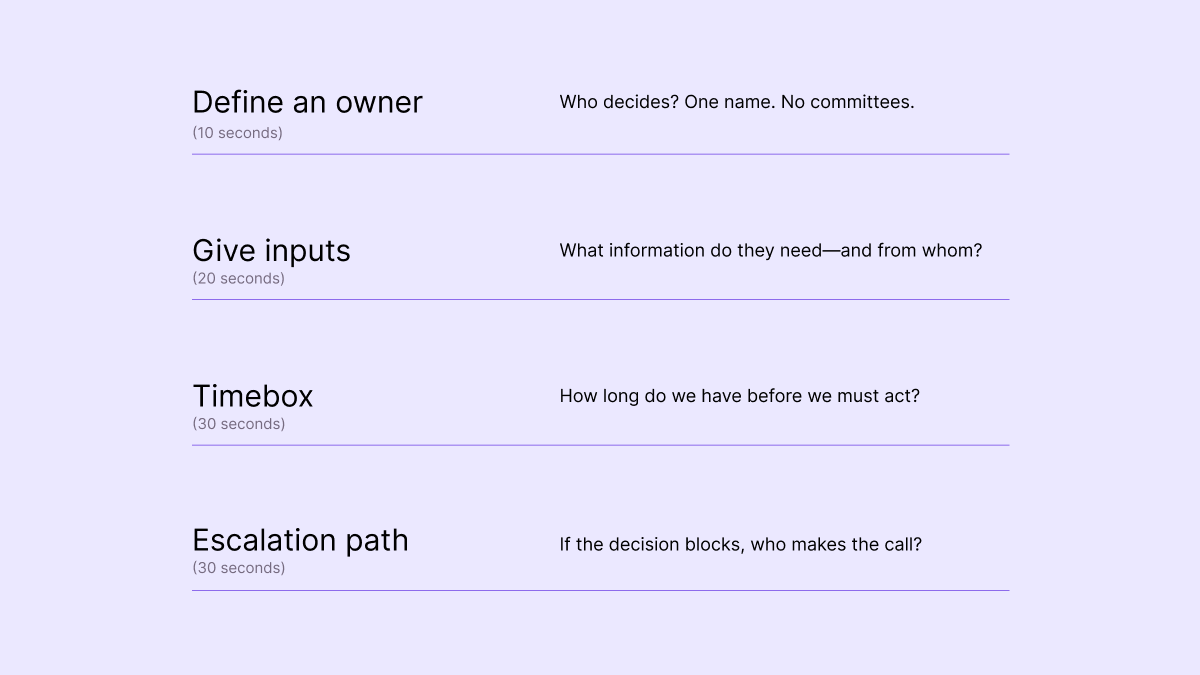
This removes ambiguity, cuts fatigue, and stabilizes teams during pressure spikes. And before big initiatives, run a premortem: “What could make this fail—and how do we avoid it?”
Why it works
Clear decision frameworks will:
- Reduce cognitive load,
- Prevent costly errors,
- Decrease late-night fire drills,
- Protect mental health, and
- Increase confidence and speed.
Research on healthy high performance shows that teams led with transformational leadership—empowerment + clarity + decisive calls when needed—outperform those with either complete-hands-off or hyper-control cultures.
As Melanie Trüb, HR Lead, put it: “People can handle pressure when they know what’s expected. Clarity removes the fear of doing the wrong thing.”
Habit 3: Protect energy to sustain performance
Elite sport has a clear rule: no recovery, no performance. Work still behaves like recovery is optional. FC Luzern treats energy as an asset to manage, not a personal problem to solve—a shift most teams need if they want sustainable pace, not accidental burnout.
What it looks like in football
Recovery = performance. At FC Luzern, recovery isn’t a suggestion—it’s scheduled, modeled, and enforced. Young players learn early that intensity must be balanced with rest. Coaches don’t just talk about it; they sell recovery as part of being elite. As Pius put it, “Most young players don’t dare to say they’re tired—they’re afraid they’ll lose their place. But if they don’t learn to listen to their body, the body forces them eventually.”
Players train hard, but they also train how to switch off, which is often the harder skill.
What it means for teams
Energy beats hours. Cognitive performance, attention, and decision quality rise and fall with energy—not with how long someone sits at a desk. Randomized field experiments show that micro-exercise boosts vigor and job satisfaction, and even a short afternoon nap improves productivity.
And inside workplaces, HR leaders see this play out daily. Claire, our very own Head of People, described her own version of energy management: a hard evening cutoff, a mental cooldown routine, and a clear boundary from absorbing employees’ stories. “I had to learn over the years that I need a mental off-switch. Otherwise, I can’t sleep.”
Melanie echoed the same from the club offices: staff who work weekends must take weekdays off, and she actively polices recovery so that “42-hour weeks don’t quietly become 52.”
What FC Luzern teaches us
- Periodized weeks—mixing high-intensity days with lighter ones
- Coaches teach players what real recovery looks like (sleep, rest, not extra private training)
- Recognition that mental overload is just as real as physical
- HR setting boundaries for staff the same way coaches do for athletes
Rüdiger added the mindset layer: “If you don’t pause when the body sends the first signals, the body will pause you later—much harder.”
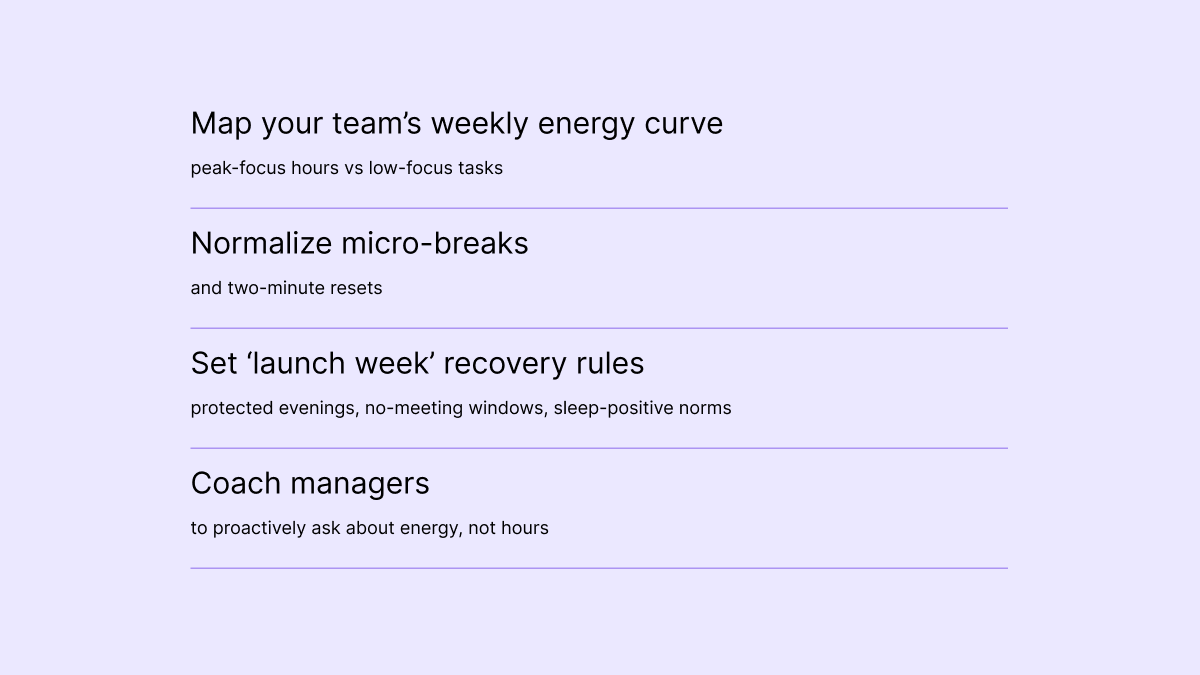
Try it with your team
Implement a 2-minute reset protocol—the same exact logic that elite athletes use.
Why it works
Teams that protect energy maintain creativity, decision quality, and resilience. They avoid the slow creep toward burnout that hits performance long before it shows up in absence data.
And absence data is expensive: Zurich alone lost more than CHF 2 billion in productivity in 2024 due to health-related absences—a cost that grows when recovery erodes.

Habit 4: Build trust that lowers pressure
Talent wins minutes; trust wins matches. FC Luzern’s culture is built on a structure that creates safety. Inside companies, trust is still treated as a “nice-to-have,” even though the performance data proves otherwise.
What it looks like in football
Trust and role clarity beat solo brilliance. In FC Luzern’s teams—from the youth academy to the first squad—trust isn’t a soft value; it’s a performance multiplier. Young players enter a system where hierarchy provides safety, not silence. As Rüdiger put it: “Clarity gives security—and security gives courage.
”One unwritten rule—the youngest waits and observes—isn’t about ego, it’s about stability. When players know the structure, they can relax into it. And when experienced teammates step forward in tough moments, younger players can also develop in peace and grow.
What it means for teams
High-trust environments consistently show lower stress, higher energy, and higher productivity. A major Gallup study converges on the same insight: when people feel included and trusted, burnout drops dramatically.
Inside FC Luzern’s offices, trust is built the same way as on the pitch—through relationship, availability, and clarity. Melanie described how she had to build trust from day one, being the first HR presence the club ever had. Now, teams “ping-pong” topics across departments; finance asks HR for perspective, marketing supports HR when needed, and people rely on each other before relying on process.
Melanie: “Trust is a given when you hire someone. If a manager no longer trusts someone, that’s already a much bigger problem than performance.”
Trust isn’t a perk—it’s infrastructure.
What FC Luzern teaches us
- “Youngest waits and observes” is a ritual that creates stability for young players
- Transparent feedback loops are key (even when the coach is blunt, it’s consistent)
- Cross-departmental support: marketing helps HR, HR helps finance, no silos
- Leaders staying calm during chaos helps build trust and connection
- Trust as the basis for autonomy—especially around flexible hours and home office
And Rüdiger’s key insight: trust strengthens resilience because it prevents players from retreating into the passive mindset. “As long as you stay in the victim role, nothing will change.”
Try it with your team
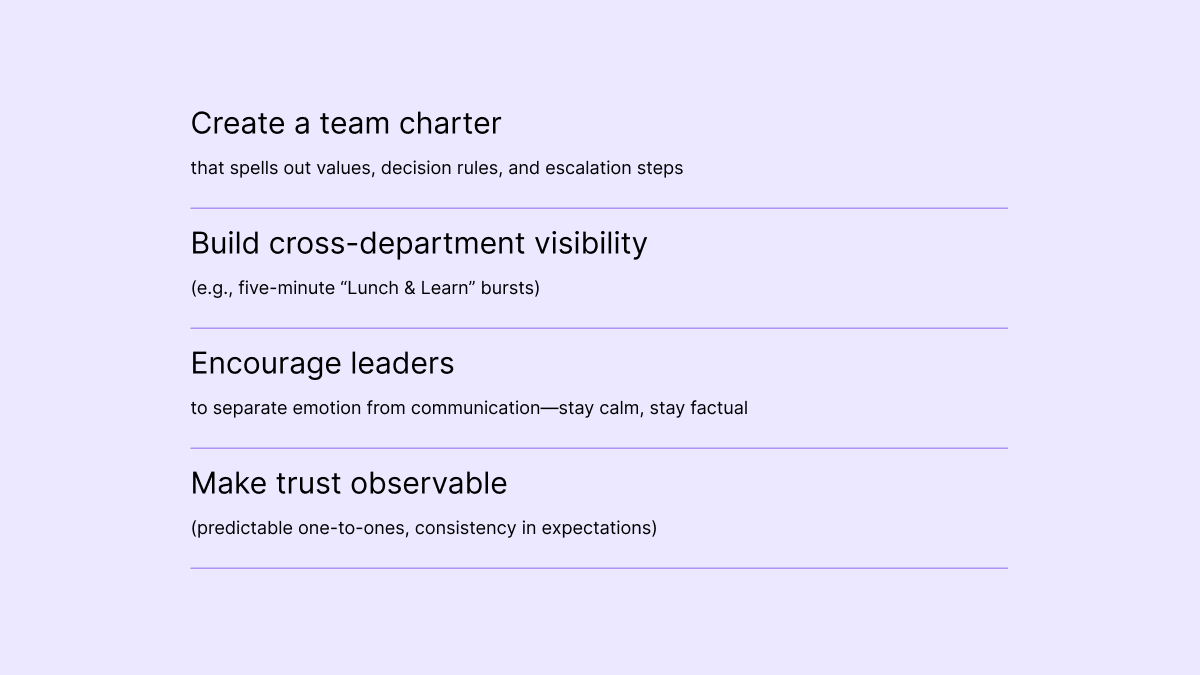
If you’re unsure about your place at work, Melanie said it best: “You’re selected because you’re trusted—that’s your starting point.” Remember that.
Why it works
High-trust workplaces show:
- Lower stress,
- Higher energy,
- More creativity, and
- Stronger retention.
Trust is protective. It reduces pressure by giving people a secure base to operate from—exactly what young players feel when stepping into FCL’s first team. And in moments of change or loss, trust keeps teams aligned and calm.
Habit 5: Find the lesson in the loss
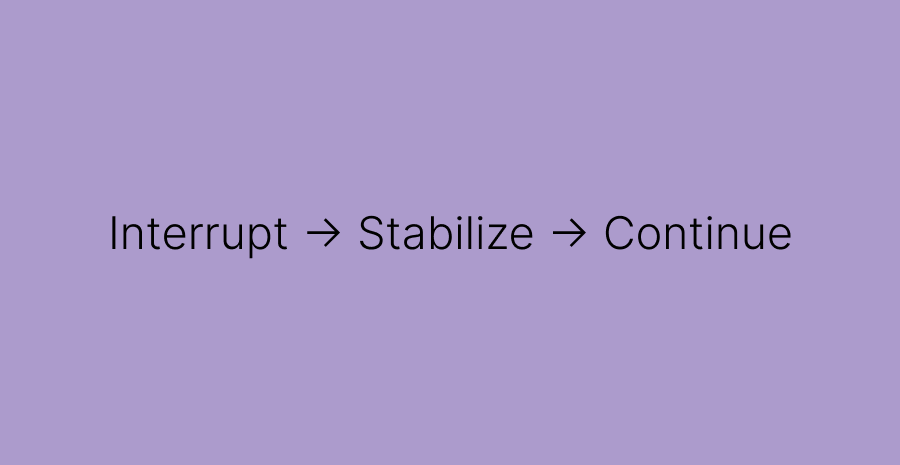
Losses, injuries, missed chances—football builds resilience through repetition. Workplaces face the same rhythm of change and disappointment, but rarely pause to learn. FC Luzern’s language after losses shows how meaning-making turns setbacks into fuel instead of frustration, strengthening confidence, clarity, and cohesion
What it looks like in football
Losses and injuries become part of training. At FC Luzern, setbacks aren’t surprises—they’re rehearsals. Young players experience failure early and often by design. Pius explained that resilience is built through controlled exposure to difficulty—not by paving the path. Football parents may try to remove every obstacle, but that only delays the inevitable.
As Rüdiger put it sharply: “Helicopter parents clear every difficulty out of the way for their kids—but then the kids reach the top and have never had to push against real resistance.”
When mistakes happen during matches—the first bad pass, the missed chance—the system kicks in: teammates help reset, the coach reframes, and the player learns to recalibrate instead of crumble. But the real shift happens afterwards: the team sits together to make sense of what happened.
Losses are reviewed with the same seriousness as wins—what did we learn, what improved, what’s next?
What it means for teams
Restructurings, failed launches, missed promotions, lost deals, strategic pivots—employees experience far more setbacks than they openly talk about. A typical corporate employee experiences multiple reorganizations in their career; each one disrupts routines and confidence. The emotional load is similar to sports: doubt, hesitation, fear of being benched (or replaced).
Melanie described it clearly in the context of FCL’s administrative side: “We are going through a massive change wave right now… and the only reason it works is because we talk, involve people, and trust each other.”
Setbacks aren't rare—they’re the environment. The differentiator is whether people make meaning from them or carry them as silent weight. Handled well, setbacks strengthen identity—individually and collectively.
What FC Luzern teaches us
- Failure is expected, not punished. Coaches share their own “mistake of the week,” modeling vulnerability.
- Reflection is immediate. Players receive clear, fast feedback—not to shame them, but to anchor learning.
- Emotion is separated from identity. A bad action does not make a bad player.
- Controlled adversity builds future capacity. Young talents are sometimes allowed to hit a wall—then guided step-by-step through recovery.
- Role models widen the safety net. Experienced players provide shadow space for young ones to recover and recalibrate. Meaning-making is collective, not individual.
These mechanisms transform setbacks into part of the developmental architecture—not personal catastrophes.
Try it with your team
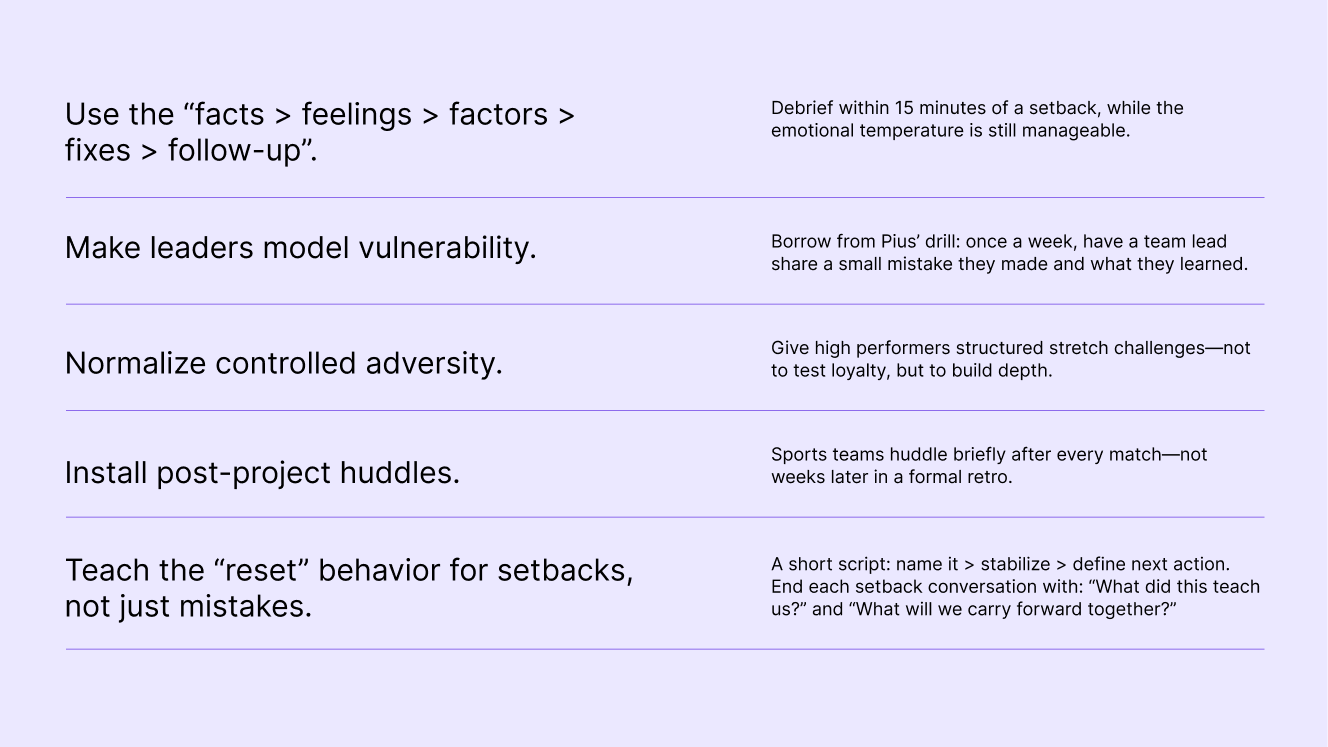
Why it works
Setbacks carry enormous emotional weight. When mishandled, they lead to:
- Shame spirals,
- Disengagement,
- Burnout,
- Slow recovery, and
- Fear-based work cultures.
When reframed—the way FCL does it—they instead produce:
- Confidence,
- Learning agility,
- Faster recovery,
- Loyalty, and
- Psychological safety.
Meaning-making turns adversity into alignment—and alignment is what holds teams steady when pressure spikes.
Now, if you’ve made it this far, it’s probably clear that resilience doesn’t come from just theory. It grows in the real world. So, after these five habits built inside FC Luzern’s system, the next natural step is simple: turn them into practice, with a workshop that your teams can run tomorrow.
From drills to skills:
The grape resilience workshop blueprint
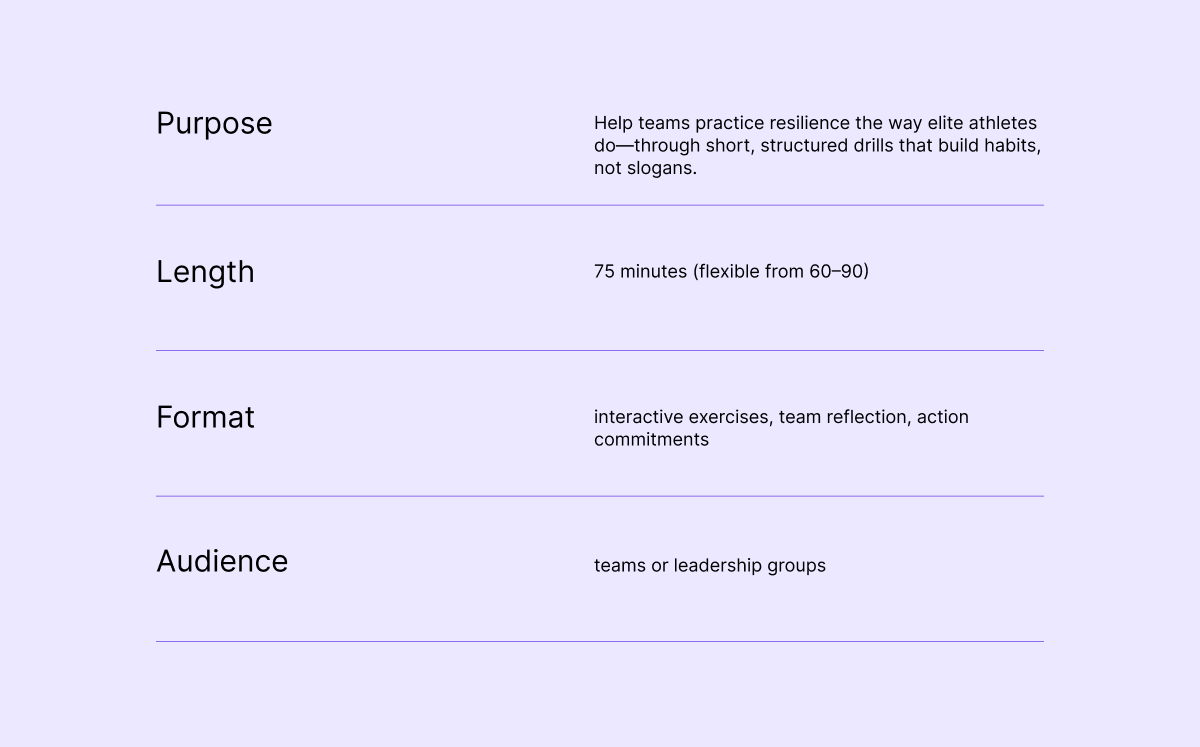
This isn’t theory—it’s practice. A (roughly) 75-minute session built like sport training: short drills, fast reflection, real habits your team can use right away. Every exercise mirrors what FC Luzern coaches, captains, and staff repeatedly told us: resilience is learned by doing, not by talking.
Metrics you can track after running the workshop
Global employer surveys show organizations are measuring the link between wellbeing programs, health plan costs, and productivity more and more each year—proof that tracking these metrics isn’t just HR hygiene, it’s business impact.
FC Luzern’s staff repeatedly emphasized the same principle: you only improve what you measure. Their weekly alignment rituals, video analyses, and post-match debriefs create tight feedback loops. These metrics do the same for organizations.
- Reduction in absence days linked to stress: Fewer days lost to stress (mirroring how FCL monitors load and recovery to reduce injury risk).
- Manager adoption of reset/failure-debrief playbooks: Playbook adoption rate (as coaches model vulnerability by sharing their own “mistake of the week”).
- Team decision speed in recurring scenarios: Faster decision cycles (similar to how players rely on pre-agreed “if–then” triggers to cut through chaos).
- Employee energy/self-reported stress levels in pulse surveys: Energy pulse score—performance follows energy, not hours.
- Engagement and retention rates in at-risk groups: Team stickiness (the same dynamic FCL sees when cohesion and clarity keep young talent progressing rather than opting out).
At the end of the day—when it comes to HR best practices—Claire said it best:
“What you don’t measure becomes a story. What you measure becomes a system.”
The conclusion—resilience as an advantage
Resilience is a system. FC Luzern shows how to practice it under pressure; and businesses can do the same. Across all of our interviews, one theme came up again and again: resilience isn’t something you hope your people have—it’s something you build together through clarity, recovery, trust, and repetition.
At grape, we help organizations put health at the heart of performance—mirroring how elite teams like FCL protect their players. Because when wellbeing comes first, resilience follows—teams recover faster, stay strong for longer, and still have enough energy at the end of the week to share a laugh together, too.